For the last couple of years, most people’s experience of generative AI has followed a remarkably simple pattern.
You ask.
AI answers.
The answer might be a paragraph, an analysis, an image, some code or a solution to a problem.
The capability behind those answers has improved extraordinarily quickly.
But there is still usually a human sitting between the AI and whatever happens next.
AI writes the email.
A person sends it.
AI analyses the information.
A person updates the system.
AI recommends an action.
A person takes it.
AI produces the code.
A person decides what to do with it.
That boundary is beginning to move.
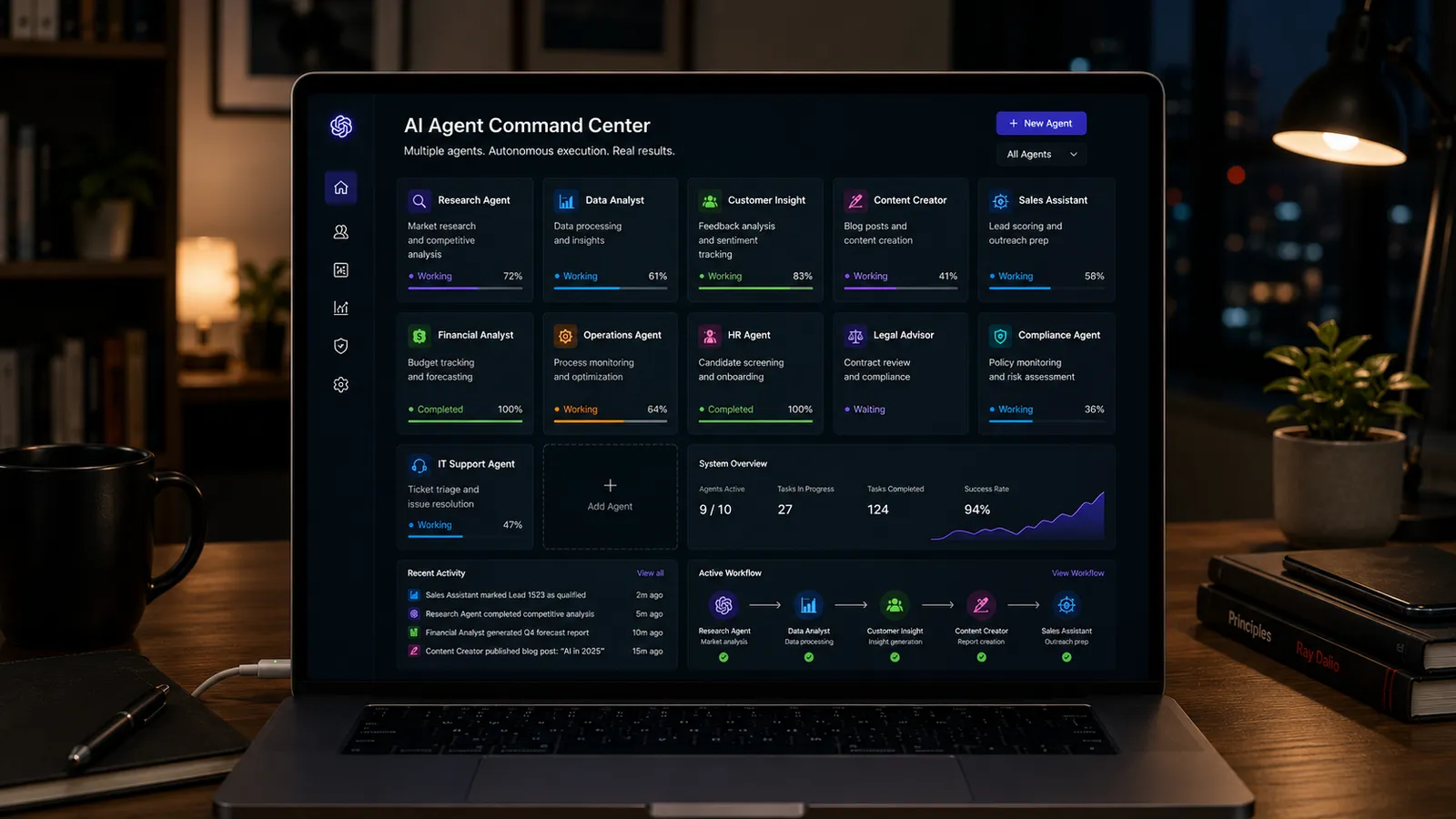
The emerging idea of an AI agent is important because the system doesn’t necessarily stop when it has produced an answer.
It can potentially use tools, interact with software, retrieve additional information, decide what needs to happen next and take a sequence of actions towards an objective.
That changes the question businesses should be asking.
Not simply:
What can AI tell us?
But increasingly:
What should we allow AI to do?
Those questions sound similar.
They aren’t.
The second one has consequences for how work, software and organisations themselves operate.
An answer is not the same as an outcome#
Imagine asking AI to identify ten companies that might be good prospects for your business.
A capable model could potentially research the market and give you a useful answer.
That’s valuable.
But the work isn’t finished.
Someone still has to evaluate the companies.
Find the right contacts.
Research them.
Check whether they’re already in the CRM.
Create or update the records.
Prioritise them.
Prepare the relevant information.
Decide what should happen next.
Assign the opportunity.
Perhaps draft some personalised communication.
The answer may have taken seconds.
Acting on it could take considerably longer.
This distinction appears everywhere.
An AI system can identify that a customer appears unhappy.
Someone still has to intervene.
It can notice an unusual financial transaction.
Someone still has to investigate.
It can identify missing information.
Someone still has to retrieve it.
It can suggest that a meeting should happen.
Someone still has to organise it.
It can tell you a process has failed.
Someone still has to do something about it.
For much of generative AI, the output of the model has been the beginning of another piece of human work.
Agents potentially change that.
The significance of an AI agent isn’t simply that it can produce an answer. It’s that the answer can become the beginning of its next action.
What makes something an agent?#
Like most terminology in a rapidly developing technology market, “AI agent” is already being used rather loosely.
Not every chatbot with a workflow attached needs a new category.
For business purposes, I think the useful distinction is relatively simple.
An AI assistant primarily helps a person perform a task.
An agent is given some degree of responsibility for accomplishing an objective.
That might require several steps.
It may need to gather information.
Use different tools.
Make intermediate choices.
Observe what happened.
Adjust its approach.
And continue until the task is completed or it reaches a point requiring human intervention.
OpenAI recently described agents as systems that independently accomplish tasks on behalf of users. In March, it released new developer tools specifically designed to make these systems easier to build, including a Responses API capable of using web search, file search and computer-use tools, alongside an Agents SDK for orchestrating agentic workflows.
This isn’t happening in isolation.
Anthropic has demonstrated Claude using a computer by looking at a screen, moving a cursor, clicking and typing.
Google has described Gemini 2.0 as a model for the “agentic era” and demonstrated Project Mariner, an experimental system capable of understanding information in a browser and taking actions through it.
Different systems will work differently.
The terminology will evolve.
Many early agents will fail.
But the direction is increasingly visible:
AI is moving from generating outputs towards participating in processes.
Reasoning makes action more interesting#
This follows naturally from the development of reasoning models.
Reasoning becomes even more consequential when the system can act on the result.
Imagine an AI system is asked:
Find the five customers most at risk of leaving and prepare an appropriate intervention for each.
That isn’t one task.
It might require the system to retrieve customer information.
Examine recent interactions.
Analyse usage.
Look for service problems.
Compare behaviour with previous churn patterns.
Identify the highest-risk customers.
Understand the commercial value of each account.
Determine an appropriate intervention.
Prepare the necessary information.
Perhaps create an action in the CRM.
Then stop and ask a human to approve what happens next.
The useful capability isn’t any individual step.
It’s the ability to navigate the sequence.
That distinction matters because business processes rarely consist of one beautifully isolated task.
They consist of chains of tasks, decisions, systems and exceptions.
If AI becomes capable of navigating more of those chains, the potential unit of automation changes.
We move from:
Can AI perform this task?
towards:
How much of this outcome can AI take responsibility for producing?
That’s a much bigger question.
Agents could change the economics of software#
Traditional business software is largely deterministic.
People use interfaces to tell software what to do.
Click here.
Complete this field.
Run this report.
Change this status.
Create this record.
Send this message.
The software performs the operation it has been explicitly designed to perform.
AI introduces the possibility of a different relationship.
Instead of telling software every step, a person may increasingly describe the desired outcome.
Find me the customers we should contact this week.
Investigate why these orders were delayed.
Prepare me for tomorrow’s sales meetings.
Find the information missing from these records.
Identify the invoices that need attention and explain why.
Research these suppliers and flag anything I should know.
The agent then determines at least some of the steps required to accomplish it.
This doesn’t eliminate conventional software.
Agents need systems to interact with.
They need data.
They need tools.
They need permissions.
They need somewhere to record what they’ve done.
But it could change the interface between people and software.
Instead of employees learning every sequence required by every system, software may increasingly become capable of navigating some of those sequences on their behalf.
That could have significant economic consequences.
Because a large amount of office work doesn’t consist of creating something from scratch.
It consists of moving information between systems, finding things, checking things, updating things, following things up and deciding what should happen next.
The workflow matters more than the demonstration#
Agents also expose one of the weaknesses in how businesses sometimes evaluate AI.
A demonstration can look extraordinary.
Give an agent an objective.
Watch it navigate a website.
See it use several tools.
Observe it complete a sequence that would have required a person.
It is very easy to jump from:
That’s incredible.
to:
We should deploy this.
But an impressive agent demonstration and a valuable business capability are different things.
The business question isn’t whether an agent can complete a task once under favourable conditions.
It’s whether the organisation can depend on it.
Does it understand the objective correctly?
Can it access the necessary information?
Does it know which information to trust?
Can it interact reliably with the relevant systems?
Does it handle exceptions?
What happens when a screen changes?
What happens when information is missing?
Does it know when to stop?
Does it know when to ask for help?
What happens when it confidently takes the wrong action?
How do we know what it has done?
Can we reverse it?
And who is responsible for the outcome?
Once AI starts acting, these questions stop being peripheral.
They become part of the product.
Reliability has a different meaning when AI can act#
A chatbot getting something wrong can be annoying.
An agent taking the wrong action can be considerably more serious.
Imagine an AI assistant incorrectly suggests that a customer should receive a refund.
A human reviews the recommendation and rejects it.
Now imagine an autonomous agent issues the refund.
Same mistake.
Different consequence.
The acceptable error rate therefore depends partly on the action the system is allowed to take.
This suggests that businesses shouldn’t think about agent autonomy as a binary choice.
There is a spectrum.
At one end, AI gathers information and suggests what a human should do.
Then perhaps it prepares the action but requires approval.
Then it might perform low-risk actions automatically while escalating unusual cases.
Only in sufficiently reliable, controlled environments might it act more independently.
The right level of autonomy will depend on the economics and consequences of the process.
Updating an internal record isn’t the same as making a payment.
Scheduling a meeting isn’t the same as changing a customer’s contract.
Drafting a response isn’t the same as sending it.
The interesting question isn’t:
Can the agent perform the action?
It’s:
Under what conditions should we allow it to?
Permissions become part of AI strategy#
This introduces another issue businesses haven’t had to think about quite as much with conventional chatbots.
Authority.
An employee has permissions.
They may be allowed to view certain information.
Change certain records.
Approve certain transactions.
Communicate externally.
Spend money.
Access confidential data.
An agent acting on behalf of that employee potentially needs permissions too.
But how much?
If an agent can search files, access the CRM, read email, interact with websites and execute functions, its usefulness increases enormously.
So does the potential consequence of getting something wrong.
This creates a tension.
The more access an agent has, the more useful it can become. The more access it has, the more carefully its behaviour needs to be controlled.
That isn’t a reason not to use agents.
It’s a reason to treat them as participants in an operating environment rather than clever chatbots.
Identity, permissions, audit trails, approval boundaries and governance become increasingly important as AI moves closer to action.
Context becomes even more important#
There is another limitation.
An agent can only pursue an objective intelligently if it understands enough about the environment in which it is operating.
Consider the instruction:
Follow up the customers who need attention.
What does “need attention” mean?
Customers approaching renewal?
Customers with unresolved service problems?
High-value customers whose engagement has fallen?
Customers with overdue invoices?
Customers showing buying signals?
Customers the sales director has personally identified as strategically important?
And what counts as an appropriate follow-up?
The answer depends on the organisation.
Its customers.
Its commercial model.
Its processes.
Its policies.
Its history.
Its priorities.
Its data.
Its definition of a good outcome.
This builds on the problem we encountered with reasoning models.
A frontier model may possess enormous general capability while understanding very little about the particular business asking it to act.
With an assistant, missing context produces a worse answer.
With an agent, missing context can produce the wrong action.
That makes organisation-specific knowledge increasingly important.
Human oversight isn’t a temporary embarrassment#
There is a tendency in technology to view human involvement as something that should eventually disappear.
The fully autonomous system is assumed to be the end state.
I’m not convinced that’s always the right objective.
Human judgement may remain economically valuable at particular points in a process even when AI performs most of the work around it.
Imagine an agent that performs 90% of the work required to evaluate a complicated customer situation but asks an experienced employee to make the final decision.
That might be an excellent system.
The employee’s time has been concentrated on the part where their judgement creates the most value.
The objective shouldn’t necessarily be to remove the human.
It should be to determine where human involvement improves the economics of the system.
Sometimes that means full automation.
Sometimes approval.
Sometimes exception handling.
Sometimes collaboration throughout.
This is why I think the most interesting future workflows will often be designed around the strengths of both humans and AI rather than around a simplistic objective of replacing one with the other.
The best agentic workflow may not be the one with the least human involvement. It may be the one that uses human judgement only where human judgement matters.
Agents make implementation the interesting problem#
As model capability improves, something slightly counterintuitive may happen.
The model itself could become a smaller part of the business challenge.
Suppose several frontier models become sufficiently capable of performing the reasoning required for a particular workflow.
Which one is marginally better may matter.
But the harder questions may be elsewhere.
How does the agent access the right information?
How does it interact with existing software?
How are permissions managed?
How is organisational context supplied?
Where does human approval occur?
How are exceptions handled?
How do employees interact with it?
How is performance measured?
How do we know it is creating value?
How does the workflow change?
Who owns it?
Suddenly we’re no longer discussing an AI model.
We’re discussing an operating capability.
And that distinction could become increasingly important.
Businesses don’t create value merely because a model can do something impressive.
They create value when that capability is integrated into the organisation in a way that reliably changes an economic outcome.
Agents make the distance between those two things unusually visible.
An agent still needs something worth doing#
There is also a danger that agents create another wave of technology-first thinking.
A company sees an agent complete an impressive task and immediately starts looking for somewhere to deploy one.
We’ve seen this pattern before.
The better starting point remains the business.
Where is valuable work currently constrained?
Where are employees repeatedly moving between systems?
Where does information fail to reach the right person?
Where do slow processes affect customers?
Where do repeated decisions consume scarce expertise?
Where are people performing predictable sequences of administrative work?
Where does a delay have an economic consequence?
Then ask whether an agent changes the economics.
Sometimes it will.
Sometimes conventional automation will be cheaper and more reliable.
Sometimes existing software already solves the problem.
Sometimes a human should continue doing it.
Sometimes the process shouldn’t exist in the first place.
The arrival of agents doesn’t change the fundamental discipline:
Start with the value, not the technology.
And because businesses can’t pursue every AI opportunity, the existence of an agentic approach doesn’t make every possible deployment a priority.
From answers to actions#
The first wave of generative AI changed our relationship with software by allowing us to communicate with increasingly capable systems through ordinary language.
Reasoning models are beginning to change the complexity of the problems those systems can work through.
Agents introduce another possibility.
AI that doesn’t stop at the answer.
AI that can gather information.
Use tools.
Navigate systems.
Make intermediate choices.
Observe what happens.
And take actions towards an objective.
We’re still early.
Anthropic describes computer use as a beta capability. Google’s Project Mariner remains an experimental research prototype. OpenAI’s agent-building platform is new, and OpenAI itself acknowledges that turning model capability into reliable production agents remains challenging.
That caution matters.
But so does the direction.
Because the transition from answering to acting changes much more than the interface.
It introduces questions about workflows, permissions, reliability, context, human judgement, accountability and organisational design.
For businesses, those may ultimately matter more than the word “agent” itself.
The question is no longer simply what AI knows.
Or even what AI can reason through.
It’s what happens when that intelligence becomes connected to the systems where work actually gets done.
For the last couple of years, the answer has often been the end of the AI interaction.
AI agents suggest that, increasingly, the answer may be where the work begins.