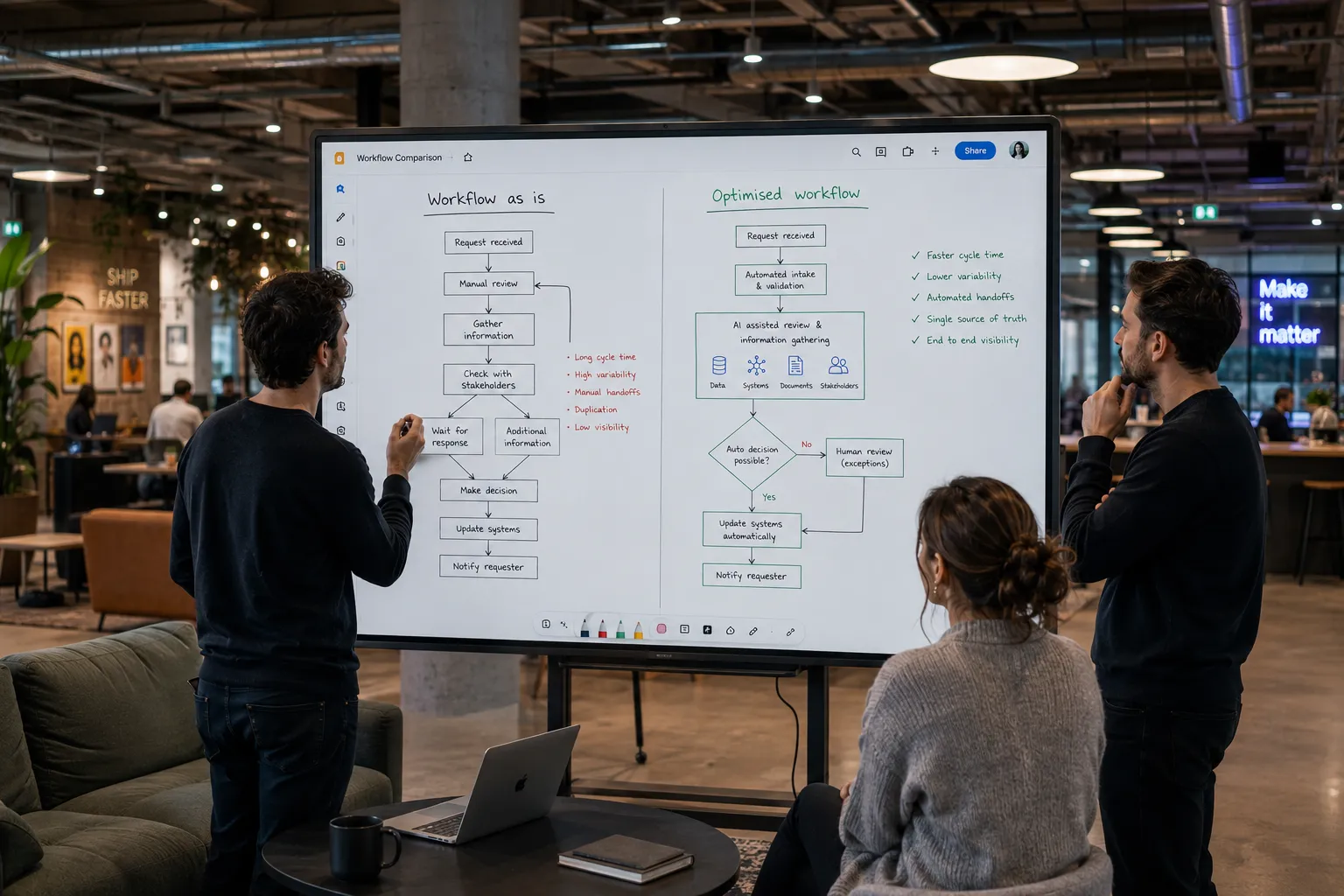
Most businesses will initially use AI to make existing work faster.
That’s understandable.
Take a task someone already performs. Give them AI. Measure whether it takes less time.
An employee spends an hour preparing for a customer meeting. AI reduces it to 20 minutes.
Someone takes 30 minutes to produce a report. AI creates the first version in five.
A customer-service employee spends ten minutes writing a response. AI drafts it almost instantly.
Value has potentially been created.
But there is a problem with this way of thinking.
It assumes the existing task should continue to exist in its existing form.
And if AI becomes as consequential as its current trajectory suggests, that may turn out to be a very limiting assumption.
Most business processes weren’t designed for a world in which software could interpret language, analyse unstructured information, reason through problems, generate useful outputs and increasingly take actions.
They were designed around the capabilities and limitations of people and conventional software.
Information had to be gathered.
Moved.
Entered.
Checked.
Interpreted.
Reformatted.
Passed between people.
Approved.
Entered somewhere else.
Communicated.
Stored.
Then perhaps retrieved again by somebody else.
AI can make individual steps in those processes faster.
But the more interesting question is whether some of the steps should still exist at all.
If you designed the workflow today, knowing what AI can now do, would you design it the same way?
Making a task faster isn’t the same as improving the system#
Imagine a business process containing ten steps.
AI makes step four twice as fast.
That’s useful.
But what if step seven remains the bottleneck?
The entire process may barely improve.
This is obvious in a physical production environment.
Imagine a factory line where one machine can process 100 units an hour and the next can process only 50.
Doubling the speed of the first machine doesn’t double factory output.
You’ve improved the machine.
You haven’t improved the system.
Knowledge work contains similar constraints, but they’re often harder to see.
An employee might produce an analysis twice as quickly, only for it to sit in someone’s inbox waiting for approval.
A salesperson might prepare a proposal in ten minutes instead of an hour, but pricing approval still takes two days.
AI might summarise a customer problem instantly, while resolving it still requires somebody to move manually between three systems.
A finance team might produce a report faster, while management still takes the same amount of time to interpret it and decide what happens next.
This creates an important distinction.
Task productivity and workflow productivity are not the same thing.
And businesses that measure AI only at the level of the individual task may miss both where value is being lost and where the larger opportunity exists.
Your workflows contain the history of old constraints#
Business processes rarely emerge fully designed.
They accumulate.
A step gets added because something once went wrong.
An approval exists because somebody once exceeded their authority.
A spreadsheet appears because two systems don’t communicate.
Someone manually checks information because the software can’t interpret it.
A report is created because the person making a decision can’t easily access the underlying data.
A customer gets transferred between departments because different employees possess different knowledge.
Eventually, the process becomes:
This is how we do it.
But hidden inside that process are assumptions about what people and technology are capable of doing.
Some of those assumptions may no longer be true.
Perhaps a person used to need to read 30 pages before deciding which information mattered.
Perhaps somebody had to classify every incoming request manually.
Perhaps an expert needed to review every case because software couldn’t distinguish the straightforward ones from the unusual ones.
Perhaps employees had to navigate several systems because none could understand the objective they were trying to accomplish.
Perhaps information had to be converted into a report because the decision-maker couldn’t interrogate the underlying material directly.
AI potentially changes some of those constraints.
That means the workflow built around them deserves to be questioned too.
The obvious AI opportunity is often inside a step#
Consider customer service.
A customer sends a complicated email.
An employee reads it, identifies the issue, searches the CRM, checks previous conversations, opens another system to inspect the order, finds the relevant company policy, determines what options are available, decides whether they have authority to resolve the issue, writes a response and then updates the CRM.
The obvious generative AI opportunity might be:
Draft the response faster.
And that may be useful.
But look at the workflow rather than the writing task.
An appropriately designed AI system could potentially interpret the incoming message, identify the customer, retrieve relevant history, inspect the order, find the appropriate policy, organise the information, identify likely resolution options and prepare the action for an employee to review.
In sufficiently predictable situations, it might eventually be authorised to complete some actions itself.
The human hasn’t necessarily disappeared.
But the work surrounding the human has changed.
Instead of spending time retrieving and assembling information, they may spend more of it applying judgement to situations where judgement matters.
The opportunity wasn’t simply:
Write faster.
It was:
Redesign what needs to happen between the customer asking for help and the customer receiving a good outcome.
That’s a much larger design space.
AI can remove coordination work, not just production work#
A surprising amount of work exists because organisations need to coordinate themselves.
Someone requests information.
Someone else finds it.
Another person interprets it.
It gets sent back.
A meeting happens.
An action gets assigned.
Someone updates a system.
Someone follows up.
A manager checks whether it happened.
None of these activities is necessarily pointless.
Coordination is essential when different people possess different information, authority and expertise.
But increasingly capable AI can potentially change the cost of that coordination.
Once AI can access relevant information, another possibility emerges.
It may be able to bring information to the point where work happens rather than requiring people to spend so much time finding it.
It may be able to identify which expertise is required.
Prepare decisions before approval.
Keep systems updated as work progresses.
Track whether actions have happened.
Escalate exceptions.
And allow a person to interact with several underlying systems through one objective.
The economic opportunity may therefore extend beyond doing existing work faster.
It may include reducing the coordination required to make the work happen at all.
Agents make workflow design much more important#
This becomes particularly interesting with AI agents.
That changes the unit of work we can potentially redesign.
A conventional AI assistant might help an employee complete one step.
An agent might participate across several.
Imagine an employee responsible for preparing for a sales meeting.
Today, they might check the CRM, read recent emails, review previous meeting notes, look at outstanding opportunities, visit the customer’s website, research recent developments, check whether support issues exist and prepare some questions.
An AI assistant can accelerate individual pieces of that work.
An agent potentially changes the workflow.
Before the meeting, it could gather relevant information from permitted sources, identify important changes, assemble the customer history, flag unresolved issues, prepare useful questions and present the employee with a concise briefing.
The employee’s job isn’t necessarily automated.
The preparation process is redesigned around them.
That’s an important difference.
The objective shouldn’t always be to ask:
Which human task can the agent replace?
It can be:
What should the human receive at the moment their judgement becomes valuable?
That is a much more useful way to think about human-AI workflow design.
Human involvement should be designed, not inherited#
There is a temptation when redesigning workflows around AI to assume that fewer humans automatically means a better process.
I don’t think that’s right.
Some human involvement exists because technology has historically been incapable.
Some exists because human involvement is valuable.
Those are different things.
A customer may want empathy from another person.
A manager may need to accept responsibility for a consequential decision.
A salesperson may understand a relationship in ways that aren’t captured in any system.
An experienced operator may recognise an exception that appears normal in the data.
A finance director may deliberately choose an option that isn’t mathematically optimal because they understand the wider commercial situation.
The goal therefore shouldn’t be to remove as many people as possible.
It should be to understand where people create distinctive value inside the workflow.
Then design around that.
AI might gather the information.
A human decides.
AI prepares the action.
A human approves it.
AI handles routine cases.
A human handles exceptions.
AI monitors what happened.
A human determines whether the process itself should change.
The best AI workflow may not minimise human involvement. It may concentrate human involvement where human judgement creates the most value.
Faster work doesn’t automatically become business value#
Imagine AI saves an employee five hours every week.
What happens to the five hours?
If they serve more customers, perhaps capacity increases.
If they spend more time selling, perhaps revenue increases.
If the organisation can absorb additional work without hiring, perhaps margins improve.
If they use the time to improve quality, perhaps customer retention changes.
But if nothing changes, the financial value may be surprisingly difficult to find.
The employee doesn’t become 12.5% cheaper simply because part of their work became faster.
This is one reason productivity claims around AI need careful interpretation.
Time saved is a capability.
The workflow determines whether the business captures it.
If AI releases capacity but the surrounding system cannot use that capacity, some of the theoretical value disappears.
This connects directly to the implementation problem.
The economic outcome doesn’t come from AI completing a task faster.
It comes from what the organisation does differently because the task became faster.
Workflow redesign is already associated with greater AI impact#
There is some early evidence supporting this distinction.
McKinsey’s March 2025 global survey examined 25 organisational attributes associated with generative AI deployment.
Of those attributes, the redesign of workflows had the largest effect on respondents reporting EBIT impact from generative AI.
Yet only 21% of respondents whose organisations were using generative AI said they had fundamentally redesigned at least some workflows.
That gap is interesting.
AI use is spreading.
Workflow redesign appears much less common.
There are obvious reasons for that.
Giving employees access to a tool is relatively easy.
Changing how work moves through an organisation isn’t.
Processes cross departments.
Systems need changing.
Responsibilities move.
Controls need reconsidering.
Employees need involving.
Measures may need changing.
Managers may need to operate differently.
Customers may experience the process differently.
The implementation challenge becomes organisational rather than merely technological.
But if the larger value sits in the workflow rather than the individual task, that difficult work may be precisely where businesses need to focus.
The new workflow doesn’t have to look like the old one#
Microsoft’s 2025 Work Trend Index offers another interesting signal.
Its research describes organisations moving towards human-agent teams and more outcome-driven ways of organising work.
In the underlying global study, 46% of leaders said their organisations were already using agents to fully automate workstreams or business processes, while 82% expected to use digital labour to expand workforce capacity over the following 12 to 18 months.
Those are expectations and self-reported behaviours, not guarantees about where work is heading.
But they illustrate the shift in the question.
If AI can increasingly reason, access context and perform actions, businesses aren’t restricted to adding an AI button to every existing job.
They can begin asking whether the boundaries between jobs, tasks and systems should change.
Perhaps one person can manage a much broader process because AI handles the coordination around them.
Perhaps a specialist can support more people because AI makes their knowledge easier to distribute.
Perhaps a team previously organised around producing information becomes organised around making decisions from it.
Perhaps software interfaces become less important because employees increasingly describe outcomes rather than navigate every intermediate step.
Perhaps some work disappears.
Perhaps entirely new work becomes viable.
We don’t know exactly where those changes lead.
But that’s precisely why simply inserting AI into today’s workflows may be too conservative.
Don’t automate a process you shouldn’t preserve#
There is an old danger in automation.
Businesses can become very good at automating bad processes.
AI makes that danger larger because the technology is unusually flexible.
If a process contains twelve steps, we can ask AI to accelerate several of them.
But perhaps the better answer is that the process should contain six.
Or three.
Or one completely different interaction.
Consider an internal report that takes several people hours to produce every week.
AI could make producing the report dramatically faster.
Excellent.
But why does the report exist?
Perhaps it exists because managers historically needed information converted into a static document before they could understand it.
If they can now interrogate current information directly through an intelligent interface, perhaps the larger opportunity isn’t generating the report faster.
Perhaps it’s questioning whether the report remains the right interface between information and decision-making.
This is the difference between automating the existing process and redesigning around the underlying objective.
The first asks:
How can AI help us do this?
The second asks:
What are we actually trying to achieve?
That second question is usually harder.
It can also be much more valuable.
Redesign starts with the outcome#
This suggests a practical way to examine workflows.
Start at the end.
What outcome is this process supposed to create?
A customer problem gets resolved.
A sales opportunity gets qualified.
An invoice gets paid.
A product gets delivered.
A risk gets identified.
A decision gets made.
A new employee becomes productive.
Then work backwards.
What information is required?
What decisions need to happen?
Where does judgement matter?
Which actions are predictable?
Which exceptions matter?
Where are people waiting?
Where is information being moved rather than used?
Where are systems forcing unnecessary work?
Which steps exist because of limitations that AI may have changed?
Only then ask where AI belongs.
This is very different from walking through the organisation asking departments for lists of AI use cases.
It begins with how value actually moves through the business.
And it treats AI as a capability that may allow that movement to be redesigned.
The workflow is where capability becomes operational#
The development of AI is giving businesses increasingly powerful components.
Models that generate.
Models that reason.
Systems that retrieve organisation-specific knowledge.
Agents that can use tools and take actions.
But businesses don’t operate as collections of isolated tasks.
They operate through systems of work.
Customers move through them.
Information moves through them.
Decisions move through them.
Money moves through them.
Responsibility moves through them.
AI creates business value when it changes those systems in economically useful ways.
Sometimes that will mean making an existing task faster.
There is nothing wrong with incremental improvement.
Small improvements applied at scale can create enormous value.
But businesses should be careful not to confuse the easiest place to insert AI with the largest opportunity AI creates.
The processes we have today were built around yesterday’s constraints.
As those constraints change, the processes should become open to challenge.
So perhaps the question for business leaders isn’t:
Where can we fit AI into the way our business works today?
It’s this:
If today’s AI capabilities had existed when we designed this workflow, would we have designed it this way at all?